

Craft Capability Ratings Explained: A Beginner's Reading Guide
Learn what craft ratings, batch-fit labels, and fabric guidance can tell you—and why they do not replace price matrices, minimums, samples, or a quote.

A decoration technique has more than a visual style. It can behave differently with fine detail, gradients, stretch, texture, washing, large areas, and different production volumes. Labelix craft pages can publish capability ratings and practical guidance to help you compare those trade-offs before designing around the wrong process.
What a capability rating means
A capability rating is an editorial comparison signal, usually shown on a one-to-five scale. A higher value means the craft is generally stronger on that dimension; it does not mean every job will achieve an exact measured result.
Use ratings to narrow a shortlist. For example, a design with tiny separated lines should favor techniques whose detail guidance supports that structure. A large tactile mark should favor a process whose texture and area guidance match the intent.
Ratings compare tendencies, not guarantees
Fabric, artwork, color, print area, operator setup, and production conditions all affect the result. Two designs using the same named craft can behave differently because their source files and garments are different.
A rating is therefore not a warranty, laboratory certification, or substitute for a physical sample. It is a structured way to ask better questions.
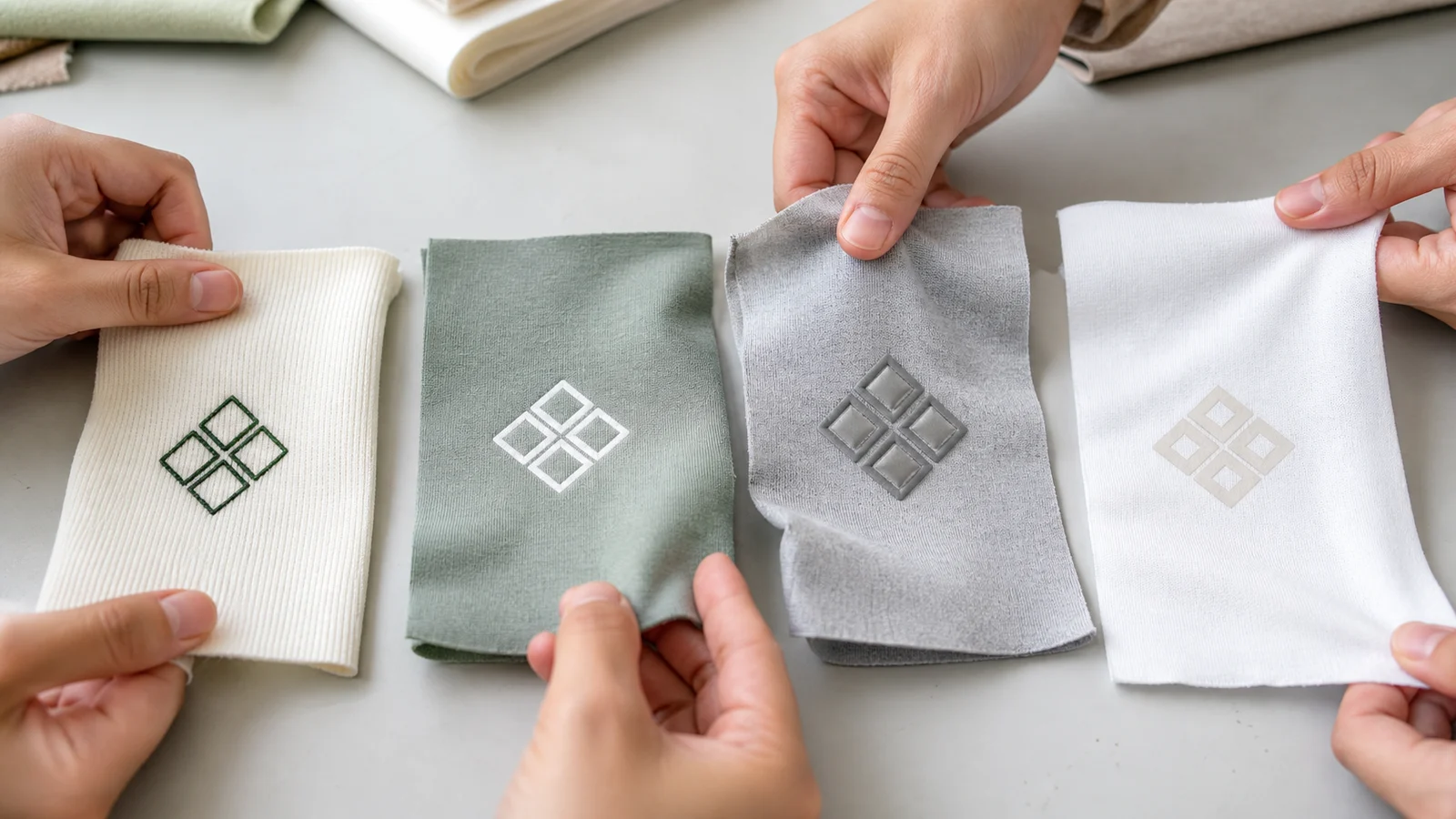
Batch-fit labels explain production scale
A craft may be described as suitable for samples, medium runs, or mass production. These labels communicate operational fit, not a secret discount.
- Samples indicate that the technique can make sense for validation or a very small run.
- Medium runs indicate a practical balance between setup and repeat production.
- Mass production indicates that the method can be well suited to larger repeated quantities.
A craft can carry more than one label. The labels do not override its actual minimum quantity, production days, or price matrix.
Fabric and fit guidance add context
Free-text guidance can explain suitable fabrics, unsuitable surfaces, preferred garment structures, and common design constraints. Read it alongside the product itself. A rigid technique may look excellent on stable fabric and perform poorly across a highly elastic panel. Heavy stitching may need more support than a lightweight material provides.
Guidance is especially valuable when the artwork crosses seams, sits on ribbing, covers a large area, or depends on exact fine detail.
What capability information does not control
Capability fields are informational. They do not calculate the quote, enforce MOQ, add a sample fee, or decide the production time. Those outcomes come from the craft's current commercial configuration and the request itself.
Keep the four sources separate:
- Capability ratings help compare likely creative behavior.
- Guidance explains material and design fit.
- Price matrix, MOQ, sample fee, and production days state commercial terms.
- The published quote defines the price and scope for your request.
A practical comparison routine
Start with the visual requirement, shortlist two or three crafts, compare the ratings that matter, then read the full fabric and design guidance. After that, compare the same area and quantity cell in each price matrix. If the project is sensitive to feel, color, or durability, plan a physical sample.
The Crafts catalog is the current source for available techniques and their published capability information.
Frequently asked questions
- Does a five-star craft rating guarantee the final result?
- No. It describes a general capability tendency. Artwork structure, fabric, print area, color, setup, and production conditions still affect the result, so a rating cannot replace a physical sample or production confirmation.
- Do batch-fit labels change the minimum quantity or price?
- No. Samples, medium runs, and mass-production labels are informational. Actual MOQ, sample fees, production days, and unit prices come from the craft's current commercial settings and the published quote.
- What should I compare first when choosing between crafts?
- Begin with the effect and material behavior the design needs, use ratings and guidance to narrow the shortlist, then compare the same area and quantity cell in each craft's price matrix.